
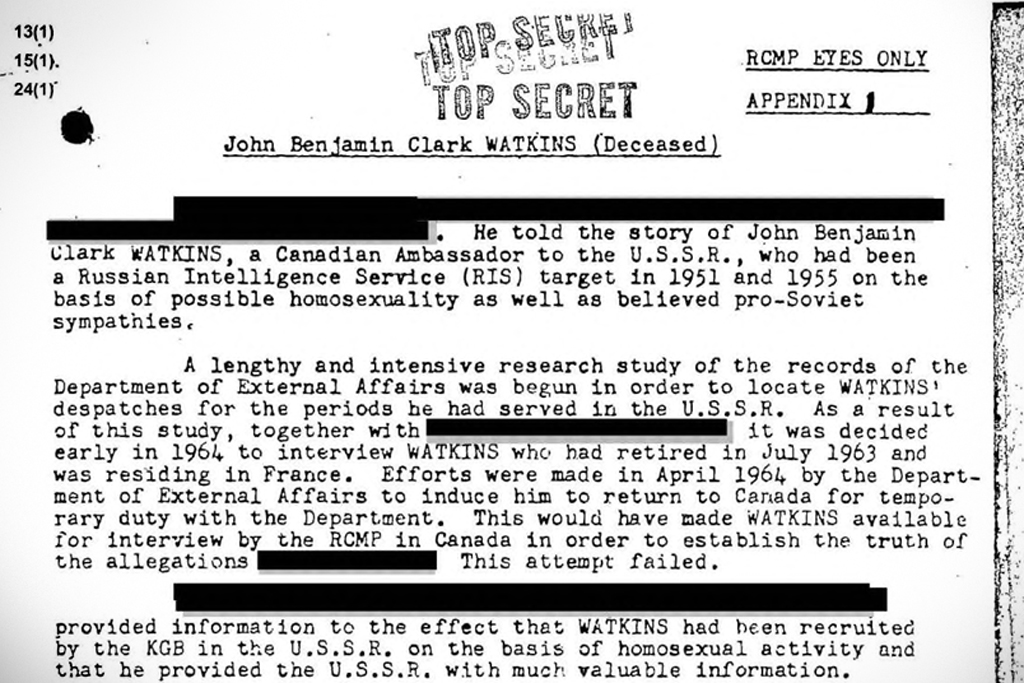
In spring 2025, we received the second batch of historical documents relating to the LGBT Purge from the Government of Canada. Collecting these documents is one of the Fund’s core activities and legally mandated under the terms of the class action settlement.
The LGBT Purge Fund contracted former member of parliament, Svend Robinson, to collect and review the documents. His review led to their structural organization and the identification of key documents. Here, we present some of Svend’s work to help guide you through these thousands of pages.
You can find all of the documents in this second batch here and the first batch is here.
Ambassador John Watkins Documents
While the Watkins documents were subjected to extensive redaction, a number of the documents disclose shocking new evidence of the real circumstances of Watkins death on October 12, 1964 while under RCMP interrogation. Document 2617 confirms that the interrogation was one of the longest of the entire period of interrogations in France, the UK and Canada. It also fails to disclose that the interrogation on that final day did continue after dinner, until Watkins’ heart attack, which is itself confirmed in document 3420.
Documents 3339 and 3340 are the first references by the RCMP to the Watkins investigation. They are from April and May 1963. Documents 3394 and 3395, from February 1964, confirm that USSEA Norman Robertson cooperated with the RCMP and that they were convinced Watkins was a KGB spy.
Documents 3414 and 3415 make clear that the RCMP had decided to take a much harder line with Watkins in the final days of interrogation and perhaps not allow him to leave Canada until issues were resolved. They would take an “aggressive” approach and challenge his honesty. Concerned about heart weakness, there was a doctor on call.
In document 3417, created after the final day interrogation, Bennett from the RCMP calls Higgitt in Ottawa to ask about next steps. It confirms that PM Pearson was aware of the situation but that SSEA was not told anything. Document 3418 shares the concern that a post-death Montreal police investigation could be a problem for the RCMP. This led to the covered up of all RCMP involvement. Document 3420 provides a key RCMP summary following Watkins’ death. It confirms that on his final day, Watkins finally admitted to buggery in USSR.
Document 4055, published in 1981, presents an internal review of RCMP documents and highlights major inconsistencies and fabrications by interrogators in the stories of what happened on the final day and the following day. In document 4179, an RCMP memo confirms that PM Pearson was well aware of Watkins’ interrogations and even gave direction. This is also confirmed in document 2617.
Document 5794 presents a transcript of a CBC “Ideas” program on Watkins from 1994. It misrepresents Pearson’s role but provides a good background from Watkins’ former DEA colleagues.
Fruit Machine and Dr. Wake Documents
Documents 3104 and 3122, from March and May 1960, provide the first references from the Privy Council Office (PCO) to a possible research project. In documents 3134 and 3135, from June 1960, we see Wake’s first “interim report,” which recommends the research project for the detection of homosexuals.
In documents 3197 and 3206, from late 1960 and early 1961, Bryce, a PCO Clerk, discusses research regarding recruitment and detection, but notes that the RCMP insists they must bar all homosexuals, criminals and also detect everyone in the public service.
Document 3217, from June 1961, show PM Diefenbaker’s approval of the project. Wake and PCO’s Wall travel to visit the FBI, CIA and NSA in the fall of 1961. The minutes from a key meeting in February 1963 are found in document 2672. They approved 10,000 in funding from the Defence Research Board for the Fruit Machine, following Wake’s 1962 report. We read that Justice Minister Fleming is fully supportive of the plan.
Documents 3308, 3410 and 3411, from 1964, confirm that a key source of subjects for the Fruit Machine research were to come from CAF gays who were already dismissed. Document 3390, from February 1964, presents a key progress report by Wake, and document 3506, from 1968, outlines the Mackenzie Commission’s support for continuing Wake’s research project.
Documents 3520, 3521 and 3523, from May 1969, provide the final reports on the Fruit Machine project.
RCMP Documents
Document 3110, from April 1960, is a key RCMP memo at the height of the Purge. It provides a comprehensive history, overview and numbers from the federal government directly. It highlights the huge impact on external affairs and the navy.
In document 3153, from September 1960, the RCMP outlines techniques for gay interviews. It notes that no lawyers were allowed and that no advance warning should be given. The RCMP’s discovery of Ottawa’s Lord Elgin Hotel as a key gay meeting place is outlined in document 3173, from September 1960.
Document 3239, from August 1961, is a key RCMP memo on the investigations of gay people, which was sent to all divisions. In document 3248, from September 1961, the RCMP outlines suspicions that an unmarried artist is likely gay.
In document 3480, from 1967, DND agrees to give information to the RCMP on discharged gays and lesbians discharged. Document 2606, from July 1973, is an internal RCMP note that the A-3 “character weakness” homosexual section has 36-37,000 cards on homosexuals. And document 3902, from May 1979, is a lengthy RCMP history of homosexuality campaigns.
Document 4110, from January 1981, is an overview of RCMP files on homosexuality and file destruction policy alternatives. From October 1982, document 4254 provides a comprehensive overview of RCMP homosexuality policy history and justification.
In document 4321, from August 1983, we read that an RCMP security service employee was discovered to be gay and would be asked about sexual orientation in interviews. Document 2579, from January 1985, is a note about RCMP Commissioner Simmonds asking Minister McKay if he has support on the “no homos” policy. The Minister agrees.
Document 4551, from May 1985, is from the most secretive federal department – the Communications Security Establishment — that highest clearance would be given to an openly gay employee. CSIS confirms this, but adds onerous conditions attached to his continued employment
In document 4909, from May 1986, Solicitor General Beatty personally supports RCMP discrimination. And finally, documents 4583, 4588, 4624 and 4656, from June 1985, provide feedback from RCMP divisions opposing gays in the RCMP. One suggests treatments to cure gay people.
DND and CAF Documents
Documents 2772 and 2773, from April 1953, present a bust of a big ring of radical lesbians and “sex perverts” in Newfoundland. In documents 2894 and 2947, from May 1958, we read that suspected lesbians in the RCAF were sent to a psych ward in the hospital. Relatedly, documents 4444 and 4464, from November 1984 and January 1985, outline how homosexuality in the military was more prevalent among women and especially at recruiting and trade training centres.
Document 4934, from June 1985, is from the DND Charter Task Force and presents a concern that if there are a small number of gays on ships, they may get better facilities. In a Combined Task Force from September 1986 (document 4982), we read that, in fact, men and women are already sharing tents in militia, which undermines a privacy argument.
Document 5005, from November 1986, is a memo from ADM De Chastelain that outlines many homophobic arguments supporting the ban on gays in the military, including the supposed threat to youth. Another memo from January 1987 (document 5021 from the PCO) states the position of Minister of National Defense Beatty on gays in military, noting “yes to women, no to gays.” Document 5028, from February 1987, presents a battle between Beatty and Minister of Justice Hnatyshyn on gays in the military. The PCO supports the Minister of Justice. Documents 5133 and 5134, from November 1987, show that PM Mulroney told Beatty that they must have Hnatyshyn’s support to continue ban. Hnatyshyn refuses.
A DND memo from May 1989, (document 5195) asks “what about pedophiles and transvestites?” And finally, in document 5528 presents a summary of a key meeting of the Conservative caucus in November 1991. In it, MP Reimer presents bigoted remarks and we read of powerful support by MP Peter McCreath and Ross Reid for a change in policy. They noted that there were gays in the House and Tory Caucus.
Security Policy Documents
Document 2627, from spring 1958, is a DND memo that refers to a “dreadful preoccupation” with homosexuality. In PCO memos 2943 and 2944, from March 1958, Bryce writes to Security Panel Secretary Dwyer referring to Diefenbaker’s request for a policy review and softer approach. Dwyer refers to “barbarous laws” on homosexuality.
Document 3104, from March 1960, is an RCMP memo on homosexuality policy, which notes PCO’s suggestion of a possible cure for homosexuality. We read that the PM is keen.
Another PCO memo from December 1960 (document 3203) outlines that they have not found a single case of homosexual betrayal or successful blackmail. It vows to keep the public uninformed of this. Communications Security Establishment documents 3322 and 3323, from February 1963, note that lesbians are less of a security risk.
Document 3376, from 1963, provides a good overview of the position of NDP Leader Tommy Douglas on security policy and calls for appeal and justice.
Document 3924, a memo by DM Solicitor General in August 1979, outlines a key meeting on homosexuality policy. In it, the Correctional Service says no gays were hired. A memo by the head of the Communications Security Establishment to MND Nielsen in September 1985 (document 4652) provides an overview of policy, including the hiring of openly gay people with the highest security clearance. And document 5183, from August 1988, is a CSIS security screening document that notes they endeavour to screen out those with recent involvement in “transsexualism” and “sodomy.”
External Affairs Documents
Document 3039, from March 1959, is an important letter from RCMP Commissioner Nicholson to the DM of External Affairs. It warns there are too many homosexuals in External Affairs and stresses that they must take action. In May 1960 (documents 3122, 3123, 3124), a key External Affairs policy on homosexuality was shared that outlines how they started using psychiatric testing for all postings. It confirms that there is “no place for homosexuals in the DEA.” Similarly, in March 1963, document 2672, from DM DEA Robertson confirms that no homosexuals are acceptable in the DEA. Document 3779, from January 1977, presents a similar position.
Documents 4307 and 4308, from June 1983, which are updates of documents 4298 and 4299, outline the draconian “behavioural standards” of External Affairs. Document 4316, from July 1983, states that no appointments of homosexuals as Heads of Post will be allowed.
Other Key Documents
Document 3749, from June 1976, is an RCMP briefing document on Toronto gay groups.
Document 5882, from August 1977, is a powerful letter from David Garmaise of the National Gay Rights Coalition to the federal government.
Documents 5877, 5878 and 5879, from April 1998, presents news stories and a press conference where Gary Kinsman released the first Purge report and demands an apology.
Document 4802, from October 1986, is a key PCO memo that outlines how PM Mulroney supports MOJ Hnatyshyn on the inclusion of sexual orientation in the CHRA.
Document 4828, from February 1986, presents the minutes of a Cabinet meeting, which was a key meeting on the government’s response to the Equality Rights Committee. In it, we read Mulroney’s eloquent remarks that gays are “God’s children” and that no discrimination is acceptable.
Document 2587, from summer 1985, is a report of DND’s official monitoring proceedings of the Equality Rights Committee. Darl Wood notes that the Committee’s minds are already made up to end the ban.
And in document 5048, from February 1987, MOJ Hnatyshyn confronts MND Beatty on inclusion of sexual orientation in CHRA and will not back down.